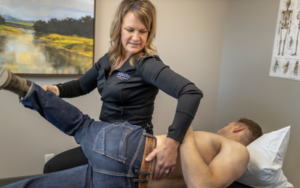
When people come into the clinic with knee pain, hip discomfort, or even low back issues, they’re often surprised when the first place we look is their feet.
But it’s something we assess often.
The way your feet and ankles move, stabilize, and absorb force plays a bigger role than most people realize. And when something isn’t working well there, it often shows up somewhere else.
It Starts From the Ground Up
Your feet are your foundation. Every step you take, every workout, every shift in position starts there. When the foot and ankle are doing their job well, they help:
- Absorb impact
- Provide stability
- Transfer force efficiently through the body
- Support smooth, coordinated movement
When they’re not, the body adapts. That might not be noticeable right away, but over time it can contribute to things like:
- Foot or heel pain
- Tight or overworked calves
- Knee discomfort
- Hip or low back irritation
- Balance changes or repeated ankle “tweaks”
The pain doesn’t always show up in the foot, but that doesn’t mean the foot isn’t involved.
What We See in the Clinic
One pattern we see often is that people don’t have a lot of strength or control in their feet.
That’s not a fault, it’s just the reality of how most of us move (or don’t move) throughout the day. Supportive shoes, time spent sitting, and flat, predictable surfaces all play a role.
Supportive footwear absolutely has its place. But over time, the smaller muscles of the foot don’t have to work as much, and they can become underactive. When that happens, the foot may become less stable or less adaptable, and the rest of the body has to compensate.
Why It Matters for the Rest of Your Body
The body works as a system. What happens at one joint affects what happens above and below it. If the foot isn’t controlling movement well, you might see:
- The arch collapsing inward
- The knee drifting out of alignment
- Increased stress at the hip
- Changes in walking or running mechanics
These are often subtle changes, but over time they can add up and contribute to discomfort or injury. In many cases, improving strength and control at the foot and ankle can make a noticeable difference higher up.
Who This Applies To
You don’t have to be an athlete to benefit from stronger feet and ankles. We commonly see this matter for:
- People who are on their feet throughout the day
- Runners or those getting back into exercise
- Individuals dealing with recurring aches or injuries
- Anyone noticing changes in balance or stability
While foot and ankle strength is especially important in activities like dance or sport, the same principles apply to everyday movement.
What Foot and Ankle Strengthening Looks Like
This type of work is usually simple, but very specific. Depending on the individual, it may include:
- Exercises targeting the small muscles of the foot
- Calf and ankle strengthening
- Balance and control work
- Movement retraining to improve how force moves through the body
Taking a More Individual Approach
Not everyone needs the same focus. Some people benefit most from improving ankle mobility, while others need more stability or control through the foot. Often, it’s a combination of both.
At Bodyworks, we look at how everything is working together, not just where the pain is. From there, we build a plan that supports your movement as a whole.
Looking Beyond Where It Hurts
If you’ve been dealing with foot pain, recurring ankle sprains, or even knee or hip discomfort that doesn’t seem to fully resolve, it may be worth looking at the foundation. Because sometimes, the reason something hurts isn’t exactly where you feel it.
And often, small changes at the foot and ankle can have a bigger impact than you’d expect. If you’re unsure where to start, we’re always here to help you sort through it and build a plan that makes sense for you. Request an appointment with Bodyworks Physical Therapy to get started.